Desk Job Hips: How Sitting All Day Is Wrecking Your Hip Mobility
 By Dr. Aalap Shah
 27 Jul, 2026
  By Dr. Aalap Shah
27 Jul, 2026
By Dr. Aalap Shah
27 Jul, 2026
You didn't hurt your hip lifting
something heavy. You didn't twist it wrong on a hike. You just... sat. At your
desk. For eight, nine, sometimes ten hours a day. And now, when you stand up,
your hips feel like rusty hinges: tight, achy, and slow to loosen up.
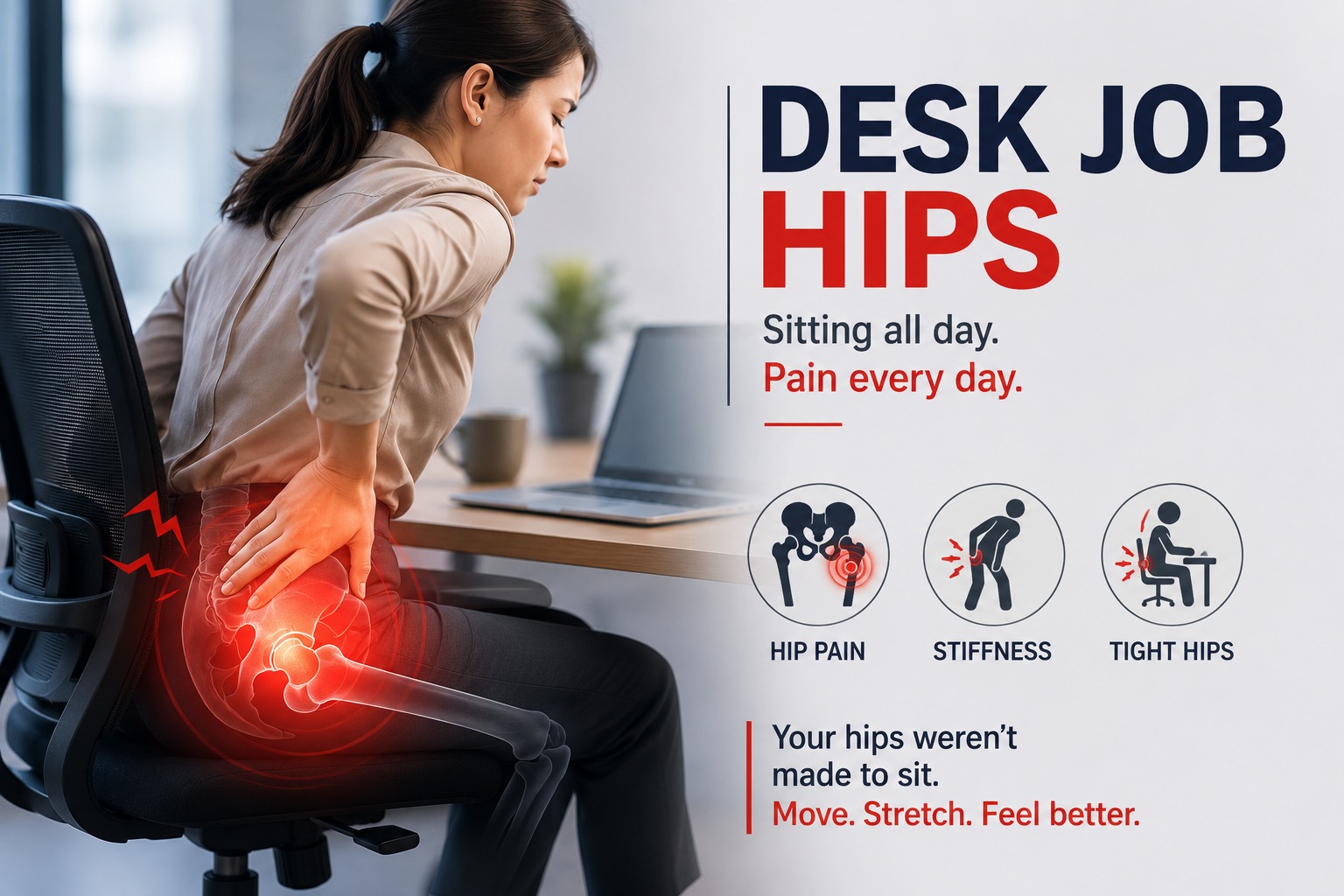
Welcome to "desk job hips"
- one of the most common, most ignored side effects of modern work life.
Why Sitting Is So Hard on Your Hips
Your hips are built to move. They're
one of the most mobile joints in your body, designed to flex, rotate, and extend
through a huge range of motion. But when you sit for hours at a time, you lock
them into one position : hips bent at roughly 90 degrees and ask them to hold
that position, over and over, day after day.
Here's what happens as a result:
Your hip flexors shorten. The muscles at the front of your
hip (especially the psoas and rectus femoris) stay in a shortened position all
day. Over time, they adapt to that length which becoming tight and losing the
ability to fully lengthen when you stand or walk.
Your glutes go quiet. Sitting compresses your glute
muscles and reduces the signal they get from your brain to activate. It’s
called as s glute amnesia" — your glutes are technically still there,
they've just gotten lazy at doing their job of stabilizing and powering your
hips.
Your hip flexors and glutes stop
talking to each other. Normally, these muscle groups work as a coordinated pair —
one lengthens as the other contracts. Prolonged sitting throws off this
balance, which can lead to poor movement patterns, lower back compensation, and
yes, pain.
Blood flow and joint fluid slow down. Movement helps circulate synovial
fluid, which lubricates your joints. Staying still for long stretches reduces
this natural lubrication, which is part of why your hips feel stiff the moment
you finally stand up.
The Symptoms You Might Be Brushing
Off
Desk job hip issues don't always
show up as sharp pain. More often, they sneak in as:
● A dull ache in the front of your hip
or groin after sitting for a while
● Tightness or stiffness when you
first stand up
● Lower back pain that seems to come
from "nowhere"
● Reduced range of motion when
squatting, lunging, or climbing stairs
● A feeling of hips being
"locked" or "stuck" during exercise
● Popping or clicking in the hip joint
Individually, these seem minor. But
left unaddressed, chronic tightness and muscle imbalance can contribute to
bigger issues — including lower back pain, knee pain, and hip impingement.
What Actually Helps (Beyond
"Just Stand More")
The good news: this is one of the
most fixable problems in the body, because the fix is simple — you just have to
actually do it.
1. Break up sitting time, not just
duration
Aim to stand, walk, or change
position every 30–45 minutes. You don't need a treadmill desk — a 2-minute walk
to refill your water bottle counts.
2. Stretch your hip flexors daily
A simple kneeling hip flexor
stretch, held for 30–60 seconds per side, can meaningfully offset hours of
sitting. Doing this once won't fix anything — the win comes from consistency.
3. Wake up your glutes
Bodyweight glute bridges,
clamshells, or banded lateral walks re-activate the muscles that sitting puts
to sleep. A few minutes, a few times a week, is enough to notice a difference.
4. Mobilize before you move
Before a workout or even before a
walk, spend 2–3 minutes on hip circles, leg swings, or a few slow bodyweight
lunges. Cold, stiff hips are more prone to strain.
5. Check your chair and desk setup
Hips higher than or level with your
knees (rather than lower) reduces excessive hip flexion. A small adjustment to
seat height can reduce the compressive load on your hip joint over the course
of a day.
The Bigger Picture
Desk job hips aren't a life sentence
— they're a signal. Your body is telling you it wants to move the way it was
designed to. The fix isn't a dramatic lifestyle overhaul; it's small, repeated
moments of motion woven into your day.
Your hips carry you through every
step, squat, and stride you'll ever take. A few minutes of attention now is a
small price for keeping them working well for the long run.
.
 Dr. Janardan Mishra

 Dr. Richa Ojha
 Dr. Disha Shah
 Dr. Bansari Patel